
Like millions, I admire Martin Luther King, and I love a good quote by him. He was such a great speaker and writer that it is hard not to be moved by his words.
But I don’t want to simply be another white person sharing a quote from King on MLK Day. I do believe that quotes and words are powerful, but there are so many injustices still happening today that something more is needed.
Yesterday I read Letter from Birmingham Jail. In this letter King addresses the white clergymen of Birmingham who have described the activities of the Civil Rights Movement as “unwise and untimely”. King expresses his disappointment in their statement and shares why his work is actually rooted in God’s Word.
Though I know the letter was written in 1963, it also seems like it could have been written just yesterday. Unfortunately, injustices are still happening TODAY, the same injustices that King fought against. If he was around today, would he see the change he dreamed of?
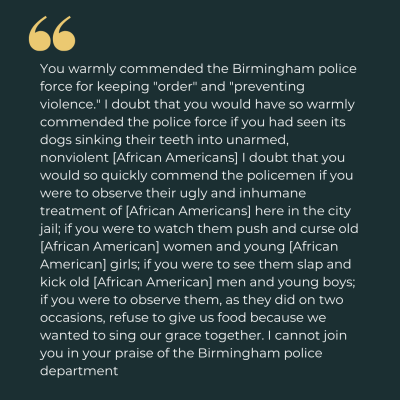
I have shared some quotes from Letter from Birmingham Jail in the hopes that it shows that injustice is still alive and well in the United States and we need to keep fighting against it. As you read these qotes, ask yourself: how am I seeing this play out today?
Quotes from Letter from Birmingham Jail
Due to restrictions on WordPress, I had to edit some of the words in order to post. The words are in [brackets].
- “But more basically, I am in Birmingham because injustice is here. Just as the prophets of the eighth century B.C. left their villages and carried their “thus saith the Lord” far beyond the boundaries of their home towns, and just as the Apostle Paul left his village of Tarsus and carried the gospel of Jesus Christ to the far corners of the Greco-Roman world, so am I compelled to carry the gospel of freedom beyond my own home town. Like Paul, I must constantly respond to the Macedonian call for aid”.
- “Anyone who lives inside the United States can never be considered an outsider anywhere within its bounds.”
- “Frankly, I have yet to engage in a direct-action campaign that was ‘well timed’ in the view of those who have not suffered unduly from the disease of segregation”.
- “Perhaps it is easy for those who have never felt the stinging dark of segregation to say, ‘Wait.'”
- “Of course, there is nothing new about this kind of civil disobedience. It was evidenced sublimely in the refusal of Shadrach, Meshach and Abednego to obey the laws of Nebuchadnezzar, on the ground that a higher moral law was at stake. It was practiced superbly by the early Christians, who were willing to face hungry lions and the excruciating pain of chopping blocks rather than submit to certain unjust laws of the Roman Empire. To a degree, academic freedom is a reality today because Socrates practiced civil disobedience. In our own nation, the Boston Tea Party represented a massive act of civil disobedience”.
- “We should never forget that everything Adolf Hitler did in Germany was “legal” and everything the Hungarian freedom fighters did in Hungary was “illegal.” It was “illegal” to aid and comfort a Jew in Hitler’s Germany. Even so, I am sure that, had I lived in Germany at the time, I would have aided and comforted my Jewish brothers. If today I lived in a Communist country where certain principles dear to the Christian faith are suppressed, I would openly advocate disobeying that country’s antireligious laws”.
- “I have almost reached the regrettable conclusion that the [African American]’s great stumbling block in his stride toward freedom is not the White Citizen’s Counciler or the [K.K.K], but the white moderate, who is more devoted to ‘order’ than to justice”.
- “In your statement you assert that our actions, even though peaceful, must be condemned because they precipitate violence. But is this a logical assertion?… Isn’t this like condemning Jesus because his unique God-consciousness and never-ceasing devotion to God’s will precipitated the evil act of crucifixion?”
- “But though I was initially disappointed at being categorized as an extremist, as I continued to think about the matter I gradually gained a measure of satisfaction from the label. Was not Jesus an extremist for love…Was not Paul an extremist for the Christian gospel…Was not Martin Luther an extremist… In that dramatic scene on Calvary’s hill three men were crucified. We must never forget that all three were crucified for the same crime—the crime of extremism….Jesus Christ, was an extremist for love, truth and goodness, and thereby rose above his environment”.
- “Let me take note of my other major disappointment. I have been so greatly disappointed with the white church and its leadership….In the midst of blatant injustices inflicted upon the [African American], I have watched white churchmen stand on the sideline and mouth pious, irrelevancies and sanctimonious trivialities”.
- “I have heard many ministers say: “Those are social issues, with which the gospel has no real concern….And I have watched many churches commit themselves to a completely other worldly religion which makes a strange, on Biblical distinction between body and soul, between the sacred and the secular”.
- “Where were their voices of support when bruised and weary [African American] men and women decided to rise from the dark dungeons of complacency to the bright hills of creative protest?”
- “Yes, I see the church as the body of Christ. But, oh! How we have blemished and scarred that body through social neglect and through fear of being nonconformists”.
- “There was a time when the church was very powerful in the time when the early Christians rejoiced at being deemed worthy to suffer for what they believed. In those days the church was not merely a thermometer that recorded the ideas and principles of popular opinion; it was a thermostat that transformed the mores of society. Whenever the early Christians entered a town, the people in power became disturbed and immediately sought to convict the Christians for being “disturbers of the peace” and “outside agitators”‘ But the Christians pressed on, in the conviction that they were “a colony of heaven,” called to obey God rather than man. Small in number, they were big in commitment”.
- “Things are different now. So often the contemporary church is a weak, ineffectual voice with an uncertain sound. So often it is an archdefender of the status quo. Par from being disturbed by the presence of the church, the power structure of the average community is consoled by the church’s silent and often even vocal sanction of things as they are”.
- “But the judgment of God is upon the church as never before. If today’s church does not recapture the sacrificial spirit of the early church, it will lose its authenticity, forfeit the loyalty of millions, and be dismissed as an irrelevant social club with no meaning for the twentieth century. Every day I meet young people whose disappointment with the church has turned into outright disgust”.
- “Is organized religion too inextricably bound to the status quo to save our nation and the world?”
- “You warmly commended the Birmingham police force for keeping “order” and “preventing violence.” I doubt that you would have so warmly commended the police force if you had seen its dogs sinking their teeth into unarmed, nonviolent [African Americans] I doubt that you would so quickly commend the policemen if you were to observe their ugly and inhumane treatment of [African Americans] here in the city jail; if you were to watch them push and curse old [African American] women and young [African American] girls; if you were to see them slap and kick old [African American] men and young boys; if you were to observe them, as they did on two occasions, refuse to give us food because we wanted to sing our grace together. I cannot join you in your praise of the Birmingham police department”.
- “It is true that the police have exercised a degree of discipline in handing the demonstrators. In this sense they have conducted themselves rather “nonviolently” in public. But for what purpose? To preserve the evil system of segregation”.
- “One day the South will know that when these disinherited children of God sat down at lunch counters, they were in reality standing up for what is best in the American dream and for the most sacred values in our Judaeo-Christian heritage, thereby bringing our nation back to those great wells of democracy which were dug deep by the founding fathers in their formulation of the Constitution and the Declaration of Independence”
 Caroline Evans
Leave a comment